7 Key Benefits of PEB Construction for Industrial Buildings
Industrial construction requires careful planning, durable materials, efficient execution and a structure that can support long-term business operations. For warehouses, manufacturing facilities, logistics centers and industrial units, Pre-Engineered Buildings (PEB) have become an increasingly practical construction solution.
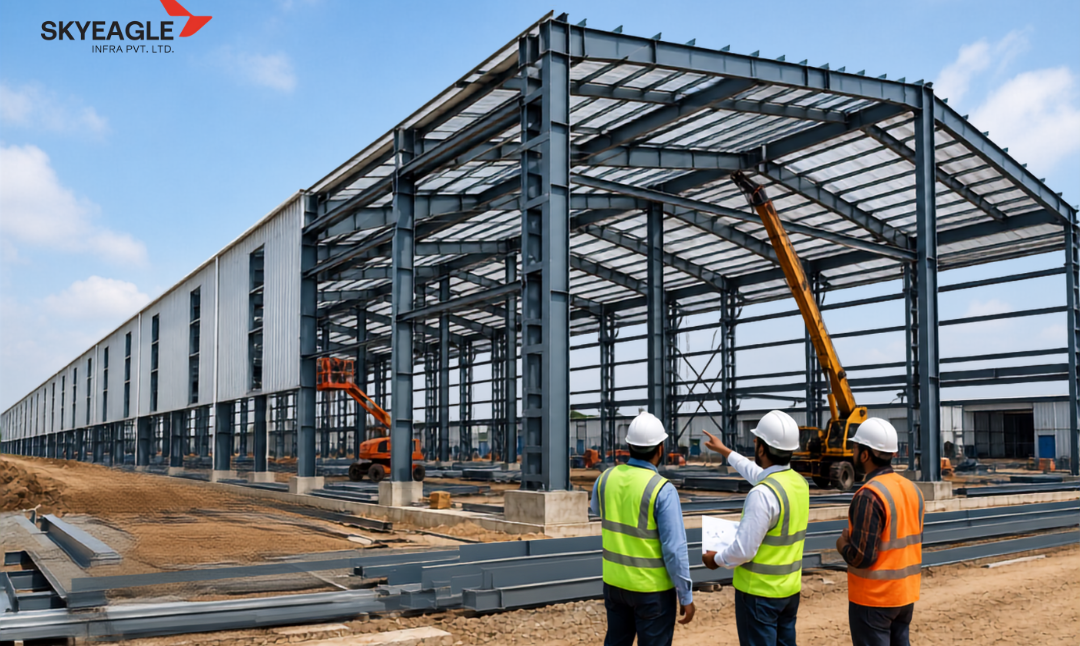
PEB construction uses specially designed steel components that are manufactured according to project requirements and assembled at the construction site. This approach can help businesses achieve faster construction, efficient space utilization, and reliable structural performance.
Here are seven important benefits of choosing PEB construction for industrial buildings.
1. Faster Construction Time
One of the biggest advantages of PEB construction is the potential to reduce overall construction time.
Unlike conventional construction methods, many PEB components are manufactured and prepared before they reach the project site. Once the foundation and other required site preparations are completed, the structural components can be assembled systematically.
For industrial businesses, faster construction can mean an earlier start to manufacturing, storage, logistics or other operations.
This makes PEB particularly suitable for businesses that need an industrial facility within a planned project timeline.
2. Efficient and Flexible Design
Industrial buildings often have different requirements depending on their purpose.
A warehouse may require large open spaces, while a manufacturing facility may need specific equipment layouts, crane systems, ventilation requirements or additional operational areas.
PEB structures can be designed according to the specific requirements of the project. Building dimensions, clear spans, roof configurations and other structural requirements can be planned according to the intended use of the facility.
This design flexibility makes PEB suitable for a wide range of industrial applications.
3. Cost-Effective Industrial Construction
Project cost is one of the most important considerations for any industrial construction project.
PEB construction can help improve cost efficiency through optimized structural design, controlled manufacturing and faster site assembly. The use of engineered steel components can also reduce unnecessary material usage when the structure is properly designed for its intended application.
However, the final project cost depends on several factors, including building size, design requirements, foundation conditions, steel specifications, insulation, roofing, flooring, electrical work and other project requirements.
Therefore, businesses should evaluate the complete project scope instead of comparing only the initial structural cost.
4. Better Quality Control
A major part of PEB manufacturing takes place in a controlled production environment.
This allows manufacturers to maintain consistent fabrication processes and quality checks before components are transported to the project location.
At the construction site, the prepared components can then be assembled according to the approved design and engineering requirements.
Proper engineering, fabrication, transportation and installation practices are essential for achieving the expected performance of a PEB structure.
For industrial businesses, this systematic approach can contribute to better project control and predictable execution.
5. Large Open Spaces for Industrial Operations
Many industrial facilities require large unobstructed areas for manufacturing, storage, machinery, material movement and logistics operations.
PEB structures can be engineered to provide large clear-span spaces depending on the structural design and project requirements.
This can help businesses utilize the available floor area more efficiently.
For warehouses and manufacturing facilities, efficient space planning can improve movement of materials, storage arrangements and future operational flexibility.
6. Suitable for Warehouses and Manufacturing Facilities
PEB construction is widely suited to applications where large and functional spaces are required.
Typical applications can include:
- Industrial warehouses
- Manufacturing plants
- Logistics facilities
- Automobile facilities
- Engineering units
- Industrial workshops
- Storage buildings
- Commercial and industrial sheds
- Factory buildings
- Expansion projects
The final building design should always be based on the operational requirements, site conditions, applicable codes and engineering specifications of the project.
7. Easier Future Expansion
Industrial businesses often grow over time.
A facility that meets today’s requirements may need additional production, storage or operational space in the future. With proper planning, a PEB project can be designed with future expansion requirements in mind.
Planning for possible expansion during the initial design stage can help businesses avoid unnecessary structural modifications later.
This is particularly useful for growing manufacturing companies, warehouses and logistics businesses.
PEB vs Conventional Construction
When deciding between PEB and conventional construction, businesses should consider the complete project requirements rather than selecting a method only on the basis of construction cost.
Some important factors to compare include:
| Factor | PEB Construction | Conventional Construction |
|---|---|---|
| Construction speed | Generally faster assembly | Often longer execution |
| Design flexibility | Highly customizable | Customizable |
| Structural material | Primarily engineered steel | Varies by project |
| Site assembly | Systematic component assembly | More site-based construction |
| Quality control | Controlled fabrication process | Depends heavily on site execution |
| Large-span requirements | Well suited | Possible with appropriate design |
| Future expansion | Can be planned | Depends on original design |
The right construction method depends on the building’s purpose, structural requirements, site conditions, budget, timeline and long-term business plans.
Why Choose an Experienced PEB Construction Partner?
Selecting the right construction partner is an important part of any industrial project.
An experienced industrial construction company should be able to understand the complete project lifecycle—from planning and engineering to fabrication, construction and project completion.
At SkyEagle Infra, our focus is on delivering industrial construction solutions with an emphasis on safety, quality, execution and project requirements.
The company provides solutions covering industrial turnkey projects, PEB manufacturing, industrial PEB construction and industrial warehouse construction.
Our approach is designed around understanding the client’s requirements and delivering practical solutions for industrial infrastructure projects.
Conclusion
PEB construction can provide several advantages for industrial buildings, including faster construction, efficient design, large usable spaces, controlled fabrication and flexibility for future expansion.
For businesses planning a warehouse, manufacturing facility, industrial shed or other industrial infrastructure project, it is important to evaluate the complete project requirements before selecting the construction method.
With proper engineering, planning, quality control and professional execution, a well-designed PEB structure can become a practical long-term solution for industrial operations.
Planning an industrial or PEB construction project in Pune or Maharashtra?
Contact SkyEagle Infra to discuss your project requirements and get a customized solution.